| This page is Sponsored By: Your Name, Your Address Refer to "Advertise on web" web page |
We specialise in xxxxxxxx birds / product Contact us on: (0X) XXXX XXXX or e-mail us @ ............. |
- Australian softbill Photo by Swagman Lures (Click on photo to enlarge)
- Scientific Name: Gymnorhina tibicen hypoleuca
- Common Name/s: MAGPIE, WHITE BACKED MAGPIE, AUSTRALIAN MAGPIE.
- Sub Species: 3 plus one in New Guinea.
- Origin / Distribution: Lower part of South Australia, Most of Victoria, Tasmania and Bass Strait islands, south-east corner of New South Wales.
- Habitat In Wild: Woodlands, parks and gardens. They usually nest in tall trees. Has adapted well to urban areas.
- Status In Wild: Common. Magpies are protected birds.
- Status In (Australian) Captivity: Very few available.
- Age To Sexual Maturity: about 3 years
- Adult plumage: attained at about ? months
- Best breeding years (estimate): 4th year onwards
- Lifespan (estimate): approx. ? years
- Sexing: Monomorphic / Dimorphic
- Colour mutations: White/albino birds can be seen in some sanctuaries.
- Availability: Specialist Breeders
- Temperament: Birds can become tame and can be hand fed. Often very territorial just prior to and during the breeding season. The Magpie's lack of shyness has made it popular with suburban gardeners and farmers both for its carolling song, and its appetite for insect pests.
- Cost (Victoria) Per Pair: - Normal colour (Approx.) $50
- Description Of Adults:
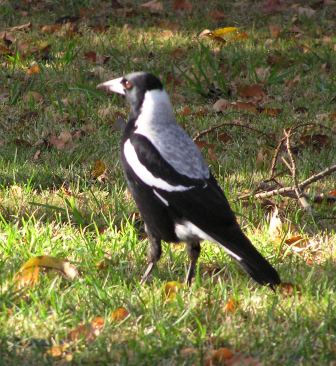
- Length: Approx. 400 mm (or approx. 11 inches) - The Tasmanian White backed Magpie is smaller than the mainland birds.
- Colour ( "normal" colour ): Refer photo above - top right of page. (Click on photo to enlarge).
- Weight: Approx. ? gms (or approx. ? ozs)
G. t. dorsalis - Western form - Found only in Western Australia. Similar to the White backed race.
G. t. tibicen - Black backed form is the nominate race and the most widespread. The Black backed Magpie is found in all mainland States. Not found in Tasmania.
The 3 races hybridize where the territories overlap.
Aviary Notes:
Level Of Knowledge Required: Beginner / Intermediate / Advanced / Specialist Breeders Only.
Government Regulations & By-Laws: Refer to "Government Laws" web page.
Housing Requirements: Click on "Housing birds" web page for general details on the housing of Softbills or read on for specific details for this finch.
In the wild, a breeding pair will have a territory of about 8 hectares (about 20 acres). The territory will have adequate food, nesting sites and a permanent source of water.
Typical large planted finch aviary is ideal, 4 metres x 1 metre x 2.1 metres high (13 x 3.5 x 7 feet).
Diet / Feeding: Click on "Feeding birds" web page for general details on the nutrition of Softbills or read on for specific details for this finch.
Natural diet includes insects, berries,
worms, frogs, small lizards and skinks, and some grains. Most foods are
found on or just below the ground surface.
Captive breeding birds require a large quantity of insects.
Suitable insects include mealworms, crickets, cockroaches, small locusts and any
insects commonly found in a garden that wild birds eat.
Nesting: A basic overview only.
- Roosting nest: Yes / No
- Nesting months: July to March
- Nesting receptacles: Wild pairs built the nest high up in a tall tree.
- Nest: The hen builds a cup shaped nest. Nest is lined with soft fine grasses and wool.
- Who incubates the eggs: Hen / cock / both share.
Breeding: Egg Colour Blue or green, brown-blotched eggs. Clutch/s per year ..usually 1, but may lay a second clutch if the first clutch is destroyed or fails to hatch. Eggs per nest 3 - 6. Incubation approx. 20 - 21 days. Fledge approx. 4 weeks. Independent = The young. in the wild, are allowed to stay in their parent's territory for up to two years. After that they are chased from the parental territory to form a loose flock with other juveniles and non-breeding Magpies. When they are mature and strong enough they may establish their own territory and begin breeding.
Two young fledging per nest is common.
Magpies are often found in groups of up to ten birds, sometimes more, however, the dominant hen is the only hen that will lay and raise young in the family group. The other birds often help with the feeding and care of the young.
Artificial incubation, hand rearing or fostering will not be covered on this web site. It is too complex and diverse in nature to be attempted here. Refer "Specific References" as listed below and "General References" listings.
Health Issues: Refer "Avian Health Issues" web page for information and references.
- Worming and parasite control and Quarantine requirements of new birds or sick birds are considered to require veterinary advice and therefore not covered on this web site. Refer above option - "Avian Health Issues" web page.
- Avian medicine is advancing at a rapid pace. Keep updating your knowledge and skills.
General References: Refer to references listed on "Book References" web page.
Specific References:
-
Australian Aviculture
- A/A Vol 22 No. 11 Nov 1968 Page 173-175.
- A/A Vol 10 No 4 Apr 1956 Page 45.
- Australian Birdkeeper